The Word That Breaks Your Brain — And Your Business
The science of free, and where to put it in your business
Both Sides of Yes | Dr. Greg Moody | Decision Psychology Under Pressure
In 2015, a 78-year-old man got punched in the face at a Costco.
Not over a parking spot. Not over money. Over a Nutella waffle sample.
Three years later, two seniors got into an altercation over a cheeseburger sample. Same store. Same basic dynamic — a small piece of food, no real monetary value, and adults willing to escalate to violence to claim it.
This is not a Costco problem.
This is a brain problem. Specifically, it's your brain — and your customers' brains — behaving exactly as designed when a single word enters the equation.
That word is free.
Why does free change what people choose?
In 2007, behavioral economist Dan Ariely ran a deceptively simple study at Duke University. He offered participants two chocolates:
- A Hershey's Kiss — free.
- A Lindt truffle — thirteen cents.
Objectively, the Lindt is the better chocolate. The price difference is negligible. By any rational calculus, most people should take the Lindt, pocket the thirteen cents mentally, and move on.
Instead, more than twice as many people chose the free Hershey's Kiss.
Then Ariely shifted everything by one cent. The Kiss went to one cent. The Lindt went to fourteen cents. Same price gap. Different result — the Lindt won decisively.
That one-cent difference from zero to one cent changed the entire decision. Not the quality. Not the taste. Not the value. Just the presence or absence of "free."
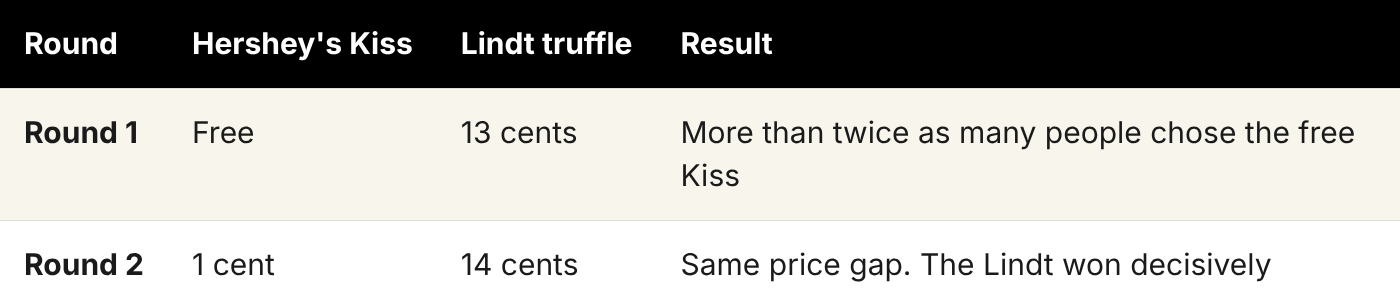
Ariely calls this the zero price effect. His finding: zero is not just a very low price. It is a categorically different kind of price — one that bypasses normal cost-benefit analysis entirely and triggers what he calls "a positive glow" that clouds judgment. When something is free, people stop weighing downsides. Risk disappears. Caution evaporates.
They just take it.
And here's what matters for you as a business owner: your customers are doing this every time you use the word — and so are you.
What does free cost you when you're the one offering it?
Most business owners think about "free" from the customer's side only. They wonder how to use it to generate traffic, trials, and leads.
That's half the picture.
The other half — the half that costs you — is what "free" does to your decision-making when you're the one deploying it.
You discount to close a deal because full price feels risky. You offer a free consultation that turns into an hour of unpaid work. You add a free bonus to a proposal trying to tip the scales, without recognizing that bonuses rarely tip scales — they just cheapen your core offer.
You give away the Lindt truffle and wonder why the customer reaches for the Hershey's Kiss anyway.
Why does free shipping beat a bigger discount?
Wharton professor David Bell studied what happens when retailers change their shipping offers. His findings should be framed on the wall of every business that sells anything — physical or digital.
Consumers preferred saving $6.99 with free shipping over saving $10.00 while paying a shipping fee.
Read that again. People chose the worse deal because it came with free.
Amazon figured this out the hard way in Europe. When they offered one-franc shipping in France — essentially nothing, less than a penny in practical terms — growth didn't match the countries where they offered free shipping. It wasn't the cost. It was the category. Paid shipping, no matter how cheap, triggers a loss aversion response. Free shipping removes that trigger entirely.
The lesson for your business: a fee is a friction, and a small fee is almost as much friction as a large fee. When you charge for something that competitors offer free, your customers experience an emotional penalty disproportionate to the dollar amount.
This isn't irrational from their perspective. It's their brain doing exactly what it evolved to do — avoid loss. You just happen to be on the wrong end of it.
Why do free samples work?
Companies spend approximately two billion dollars per year on product sampling. That's not charity. That's a calculated investment in one of the oldest psychological mechanisms in human behavior: reciprocity.
When a person receives something, even unsolicited, they feel obligated to return the favor. This is not a Western consumer preference. Anthropologists have documented it in every culture studied. It is how humans operated before currency existed.
Costco's cheeseburger sample? The company running that program knows exactly what they're doing. Marsh supermarket found that 68 percent of samplers purchased the product they sampled. Ziploc ran a sampling program at Costco and saw a 156 percent sales increase. Cheese, wine, beer, frozen pizza — sales increases from sampling programs range from 71 to 600 percent.
The mechanism is not "I tasted it and liked it." That's part of it. The deeper mechanism is: someone gave me something, and I now feel a subtle but real pull to give something back.
In a martial arts school context: when a student's first class is genuinely excellent — not a sales pitch disguised as instruction, but real teaching — and it's offered as a free trial, you've triggered reciprocity. The parent who walks out thinking that was actually valuable is not in a neutral decision state. They're carrying a slight weight on the give-back side of their internal ledger.
That's why the free trial class, executed well, works. Not because you tricked anyone. Because you gave real value first, and the brain's accounting system noted it.
When is free actually the right strategy?
Ariely tells us free breaks the brain. But Chris Anderson — former editor of Wired and author of Free: The Future of a Radical Price — makes a provocative case that free isn't just a psychological trick. For certain business models, it is the entire architecture.
Anderson's argument: in the digital economy, the marginal cost of reproducing information goods approaches zero. Music files. Software. Articles. Video. When it costs nothing to make another copy, the competitive pressure to offer free becomes nearly irresistible. The business that charges while competitors give away will lose — not because of psychology, but because of economics.
Anderson mapped four models where free is a legitimate and deliberate strategy. Cross-subsidies, where one product funds another — think mobile carriers subsidizing the phone to lock you into the plan. Two-sided markets, where users are free because advertisers pay — Google, search engines, free apps. Freemium, where the basic version is free and a minority of power users fund the premium tier — Dropbox, Spotify, every SaaS company you've used in the last decade. And the gift economy, where contributors give freely and reputation is the return — open source software, Wikipedia.
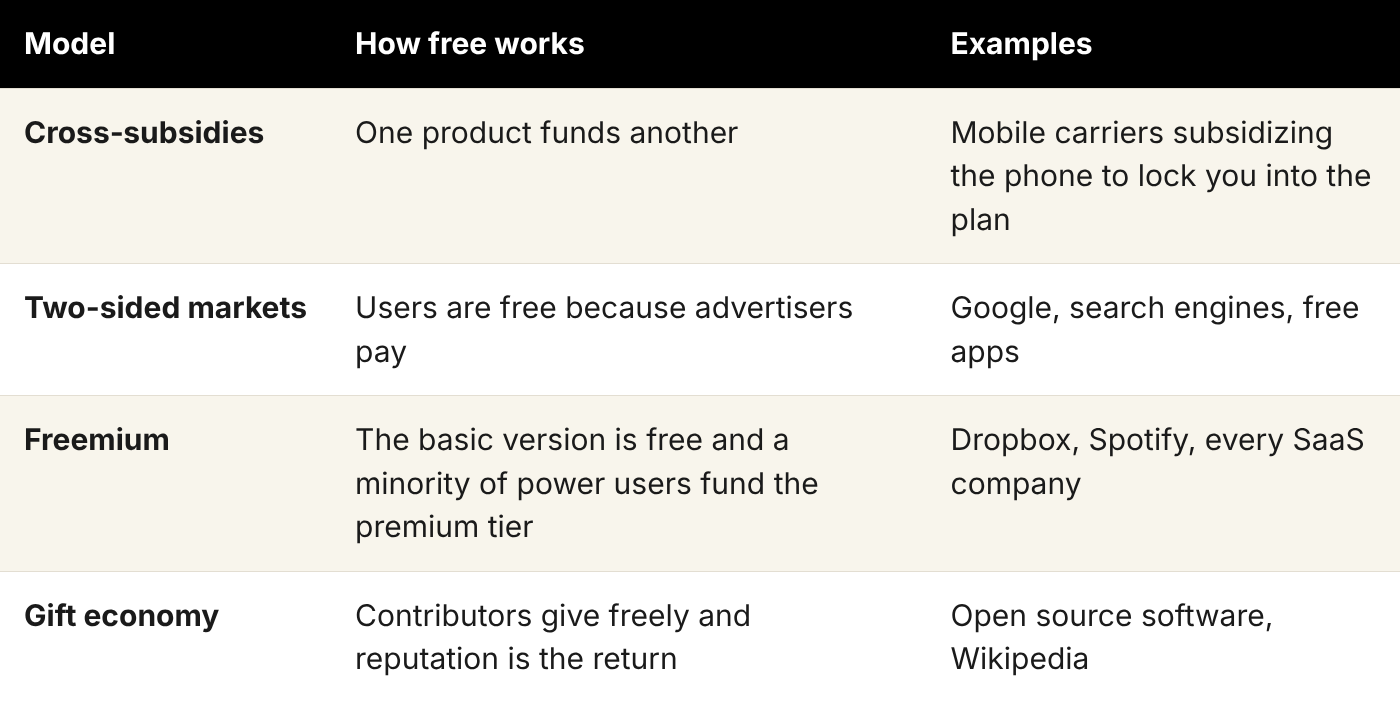
Anderson published this in 2009. Fifteen years later, freemium is the dominant model in software, media, and services.
The tension between Anderson and Ariely is worth sitting with. Anderson says: give it away, because abundance economics reward the business that removes friction first. Ariely says: be careful, because free rewires expectation and makes the transition to paid painful. Both are right.
They are studying the same word from different angles. Anderson is describing business architecture. Ariely is describing psychological behavior. You need both frameworks in your head simultaneously — especially when you're deciding whether to charge for something new, build a free tier, or redesign an offer.
The businesses that get this right aren't choosing between Ariely and Anderson. They're using Anderson to decide where to put the free, and Ariely to understand what happens in the customer's head once they get it.
How do business owners get free wrong?
The mistake most owners make with the zero price effect is one of two extremes.
The first extreme: they underuse it. They charge for things that competitors offer free — small fees, introductory costs, intake charges — and lose customers to the psychological penalty of "not free" without ever realizing why.
The second extreme: they overuse it. They put free on everything. Every consult is free. Every follow-up is free. Every add-on is free. And the result is a customer who has been trained to never pay — and who now unconsciously devalues the work because it carries no price signal.
Price communicates value. Zero price communicates zero value. This is not just consumer psychology; it's how we are wired to interpret the marketplace. Free works when it creates reciprocity and leads somewhere. Free fails when it's a habit masquerading as a strategy.
The calibrated use of free is: free at the front, paid at the depth.
Free trial. Paid membership.
Free consultation. Paid retainer.
Free shipping threshold. Paid below it.
Free content. Paid transformation.
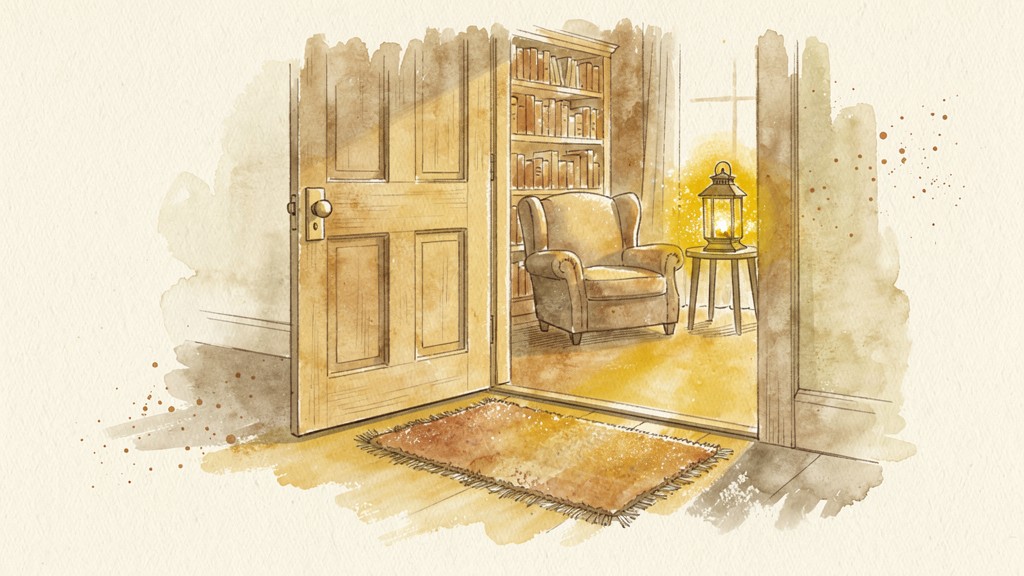
The free is the door. The paid is the room. If your free is too deep into the room, you've lost the architecture.
What are you really promising when you offer something free?
Here's the framing that sharpens this for high-stakes business decisions:
Every time you offer something free, you are not just choosing a price point. You are making a psychological contract with the other person's brain — promising them a specific emotional experience (no loss, no risk, no friction) that they will measure every future interaction against.
If you build a relationship on free and then introduce cost, the transition has to be engineered carefully. The customers who got the Hershey's Kiss for free will not automatically pay for the Lindt truffle later. You have to rebuild the value architecture — show them what the truffle is, why it's worth the price, and make the price feel like access rather than extraction.
This is not manipulation. It is the application of real decision psychology to real business problems. The science exists. Ariely documented it. Bell confirmed it with shipping data. Billions of sample-generated sales validated it.
The question isn't whether the zero price effect applies to your business.
It does.
The question is whether you're the one using it — or the one it's being used on.
What to Do With This
Three moves you can apply this week:
1. Audit your "free" exposure. List everything you offer free. Ask: does each item create reciprocity and lead somewhere paid? Or does it just reduce your perceived value? Cut or restructure anything that's in the second category.
2. Examine your fee frictions. Are there small fees — intake charges, deposit requirements, minor add-ons — that are generating loss-aversion responses out of proportion to their dollar value? Consider whether removing them or reframing them changes your conversion rate.
3. Protect your paid tier's psychology. If you have a free level and a paid level, make sure they are categorically different — not just more of the same. The brain accepts "free gives you this, paid gives you that." It resists "free gives you this, paid gives you slightly more of this."
The decision about how to use free is not a marketing decision. It is a psychology decision. And like all psychology decisions, it rewards the person who understands what is actually happening inside the other person's head.
If this framework is useful to you, there's more where it came from. The 5-Step Decision Checklist is a practical tool I use before any significant business move — pricing changes, hires, partnership decisions. Grab it here and put it to work.
If you're making a high-stakes decision right now and want a 30-minute outside perspective, book a strategy call. I'll tell you whether I can help — and if I can't, I'll tell you that too.
Dr. Greg Moody holds a Ph.D. in Education from Arizona State University and applies decision psychology to business performance. This content is educational and does not constitute professional psychological services.
Word count: ~1,850 words
Pillar: Decision Frameworks + Decision Breakdowns
Source article: HubSpot — "Why Free Stuff Makes Us Irrational" (Dan Ariely / zero price effect research)
Book referenced: Chris Anderson, Free: The Future of a Radical Price (2009)
CTA: Decision Checklist lead magnet + Strategy Call